
Orange County Projected Release Dates
A projected date is a sentence calculation based on the judgment, credit, applicable law, and the correctional agency's current data. It is forward-looking. An actual release date is historical proof that the prison or jail custody phase ended. NCDAC can display both fields on a detailed state offender record, along with the most recent movement and separate supervision status. The two dates should never be treated as interchangeable.
A person awaiting trial in the Orange County Detention Center ordinarily has no sentence-based release date. Bond, a written promise, a court order, dismissal, or a hold from another matter controls the next move. A person serving a qualifying local misdemeanor sentence may have a calculation tied to the court judgment and jail credit. A state prisoner at Orange Correctional Center has an NCDAC calculation. These systems answer different questions.
Find Orange County Release Dates
Begin with the facility and sentence type. The NCDAC Offender Public Information search is appropriate for a state prisoner. The Orange County jail and clerk records are appropriate for a local sentence or pending case. A public portal result is a lead; the detailed record and agency file provide the context needed to interpret it.
- Confirm whether the last known location was the county detention center, Orange Correctional Center, another NCDAC prison, or federal custody.
- For NCDAC, search by the seven-digit offender number when known. Otherwise use name and identifiers, and include All status.
- Open the detailed record. Compare Inmate Status, sentence history, Last Movement, Projected Release Date, Actual Release Date, and supervision status.
- For a county case, obtain the judgment and custody credit from the Orange County Clerk, then ask the jail records custodian for the actual release transaction.
- Check another agency's locator when a detainer or transfer appears. Do not turn a departure from one facility into a claim of community release.
The complete county search and release-record workflow is available on the Orange County released inmates home page. Note: Match the case number and booking episode before comparing a court sentence with a jail release event.
Orange County Sentence Calculation Paths
The words “release date” can describe three very different Orange County situations. A pretrial detainee has no active sentence to calculate. The next custody change depends on bond, a written promise, a court order, dismissal, or a hold in another case. A sentenced person held locally may have jail credit and misdemeanor earned time applied to a court judgment. A state prisoner has a minimum and maximum term administered by NCDAC under the sentence law that applies to the offense date and class. The same shortcut cannot be used for all three.
Start with the filed judgment. It shows whether a term is active, suspended, concurrent, or consecutive and may show credit for time already served. Concurrent terms run at the same time, while consecutive terms run one after another. That difference can change the controlling end point. NCDAC or the jail then administers the sentence under governing law and policy. A public projected field reflects that work as of the record’s current data; it is not authority to recalculate the judgment independently.
| Orange County custody path | Correct date source | Key limit |
|---|---|---|
| Pretrial detention | Court orders plus the sheriff’s release transaction | No sentence-based projected date exists before an active judgment. |
| Qualifying local sentence | Judgment, custody credit, and detention-center administration | The misdemeanor earned-time rule differs from state felony rules. |
| NCDAC prison sentence | Detailed OPI record and NCDAC sentence data | Projected release, actual release, supervision, and discharge are separate fields or events. |
| Older parole-eligible sentence | NCDAC record and Commission decision material | Eligibility or approval does not itself prove the date of physical release. |
Physical movement can still differ from the calculated date. Weekends, holidays, transportation, court changes, and other-agency holds may affect when someone leaves a particular site. Orange County research found no universal release hour. It also found no county policy promising an automatic public display for a set release window. Obtain the release transaction after the event when the exact date, time, code, or destination matters.
Orange County NCDAC Date Fields
The general NCDAC form allows All, Active Inmate, Active Probationer-Parolee, and Inactive status searches. It also provides name, sounds-like, offender number, gender, race, ethnic group, birth-date, and age filters. Released people should not be searched only as Active Inmates. Inactive can refer to a completed component and must be read within the full record.
The detailed record separates prison status from community supervision. Most Recent Incarceration Summary, sentence history, Last Movement and date, detainers, Actual Release Date, Projected Release Date, and service status can appear. A state release to post-release supervision is a real exit from prison but not a full discharge from correctional control.
Orange County NCDAC Release Index
NCDAC also provides a dedicated Inmate Releases search. It accepts county with year and month, or a last-name prefix with a sounds-like option. Orange is county code 68. The observed selector offered only 2024 through 2026 on the research date, so this is a recent monthly state index rather than a complete historical file. Results can show offender number, name, release date, primary offense with qualifier, and type of release. The offender number opens the full history.
That monthly index covers NCDAC releases. It does not list people who bonded out or completed a stay at Orange County Detention Center. County code 68 must not be read as an Orange County Sheriff release feed. Use general OPI with All or Inactive for an older state release, then verify the dated Actual Release Date or movement history in the detailed record.
Orange County Earned-Time Rules
North Carolina Structured Sentencing applies to felonies committed on or after October 1, 1994. For those felonies, ordinary parole was eliminated, subject to distinct exceptions. Under G.S. 15A-1340.13(d), a Structured Sentencing felon serves 100 percent of the judicial minimum. Earned time for an approved work assignment or full-time program may reduce the maximum toward that minimum but never below it.
The often-repeated 85 percent description refers to how the maximum is structured. It is not a universal walk-out date. The minimum, maximum, jail credit, offense date and class, consecutive sentences, discipline, earned time, court changes, and post-release supervision all matter. A calculator that simply takes 85 percent cannot account for those facts. The official felony minimum-term rule shows that controlling floor.
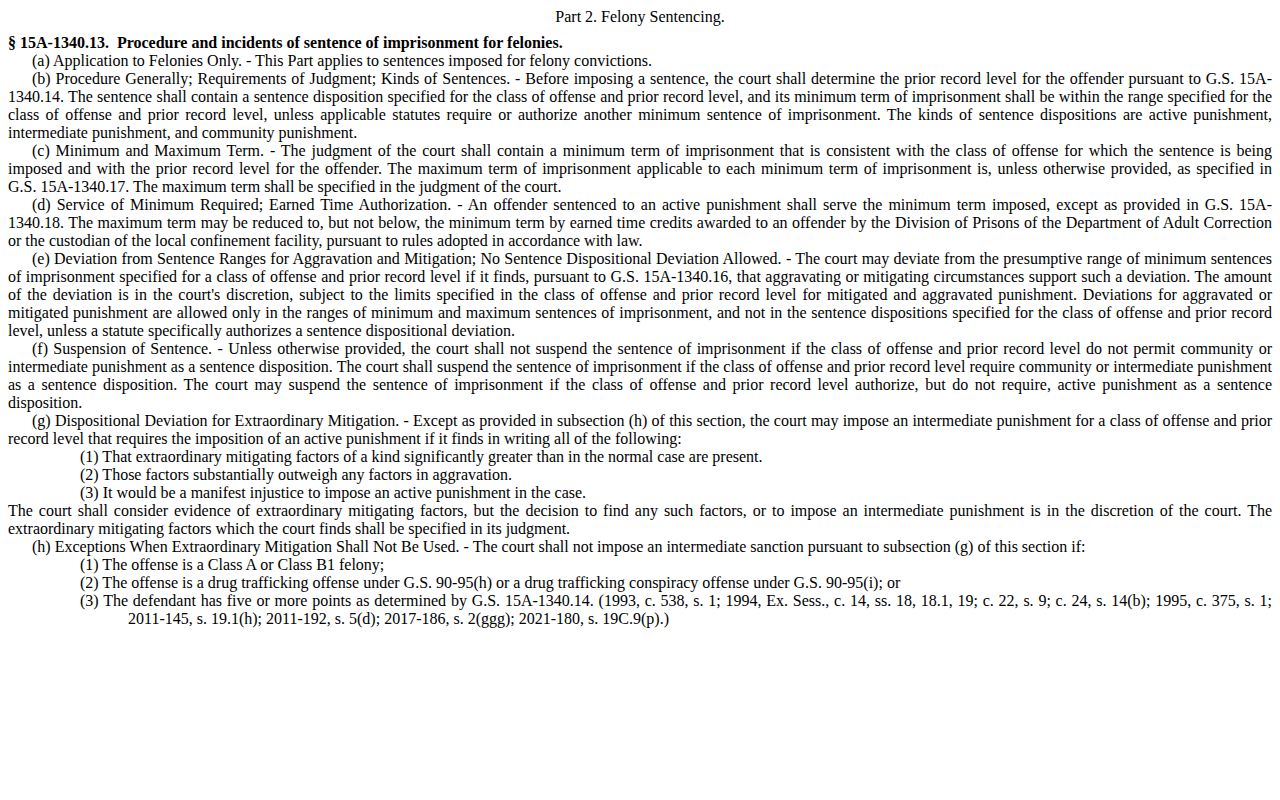
The statute confirms why the judicial minimum is the floor rather than a date that a generic percentage tool can reduce.
Orange County Misdemeanor Earned Time
An activated misdemeanor follows a different rule. G.S. 15A-1340.20(d) permits work and earned time with the combined award capped at four days per month. That can matter for a qualifying local jail sentence. Bond release is not an earned-time calculation because no active sentence is being shortened.
The official misdemeanor earned-time provision shows the distinct local-sentence rule.
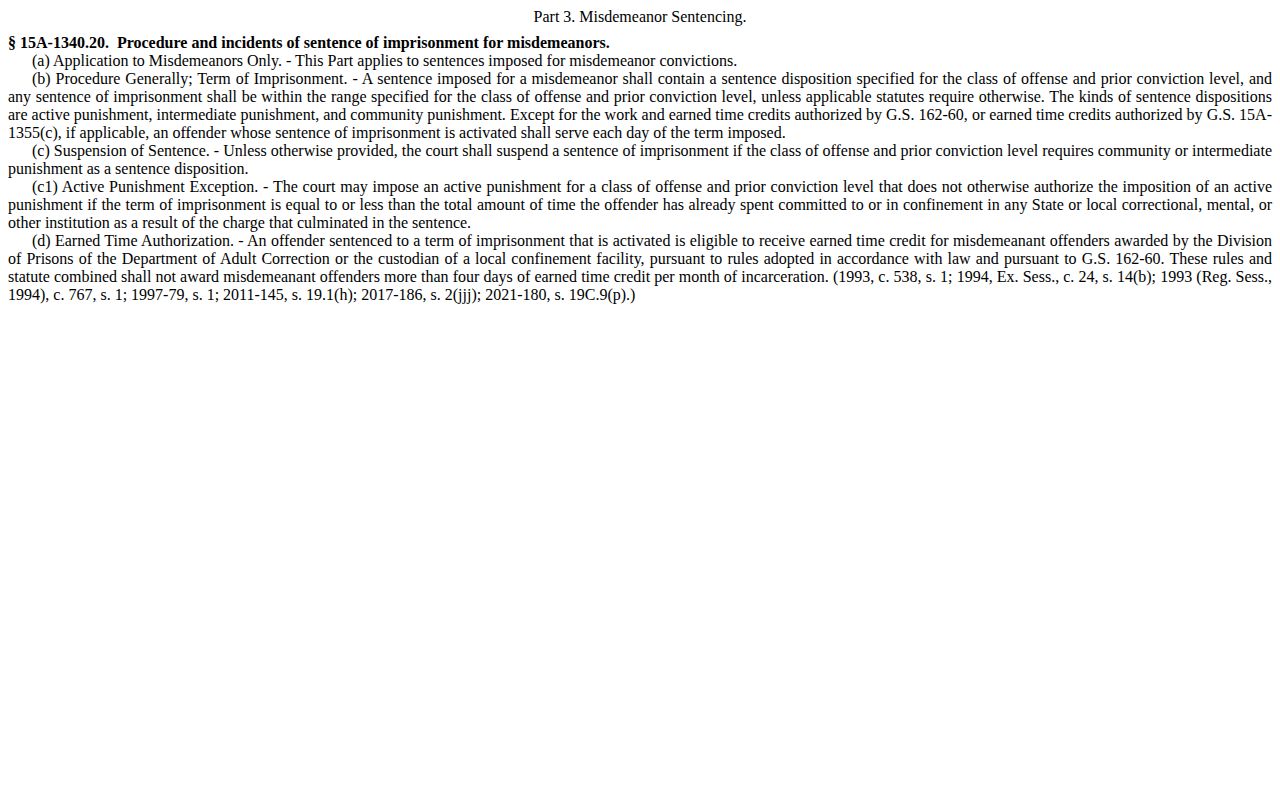
This limit belongs to an activated misdemeanor sentence and should never be substituted for the state felony minimum-term framework.
Orange County Release to Supervision
G.S. 15A-1368.2 governs release onto post-release supervision for covered North Carolina terms. Class B1 through E terms generally use the maximum less twelve months, and Class F through I terms generally use the maximum less nine months, less earned time. Registration offenses follow different provisions. The exact record and statute control.
This event is both an actual prison release and the start of supervision. The person is no longer confined under that prison phase, but NCDAC still exercises correctional authority. Completion of supervision ends the sentence under the statutory framework. NCDAC therefore separates Inmate Status from Probation/Parole/Post Release Status. Both fields should be read before describing a person as discharged.
- Projected release
- A current estimate before the move occurs.
- Actual release
- A recorded exit from that custodian.
- Post-release supervision
- Community oversight that follows prison for covered sentences.
- Discharge
- The end of the sentence or supervision phase shown in the record.
Why Orange County Dates Change
A projected date is recalculated when the legal or correctional inputs change. The public record may lag behind an internal update. A future date also does not account for a later arrest or unrelated hold that has not yet reached the display. These limits are why the dated movement history and the originating office remain important.
| Factor | Effect on the date |
|---|---|
| Earned time | May move a maximum-term calculation toward the statutory minimum. |
| Disciplinary action | Loss of credit can move a projected date later. |
| Jail credit | Credited pre-sentence custody changes time remaining. |
| Consecutive sentences | One term follows another and alters the end point. |
| Court order | An amended judgment or other lawful change can require recalculation. |
| Detainer or hold | The person may leave one custodian but enter another. |
| Supervision rule | The prison exit and final discharge occur on different dates. |
Parole affects mainly eligible older-law cases. The North Carolina Commission does not hold formal hearings with offenders. It reviews eligible cases and publishes retrospective monthly decision spreadsheets, but eligibility or approval is not itself an actual release date.
Orange County Jail Date Limits
Orange County Pretrial Services may supervise a person released before trial, but that release depends on the court and is not a sentence computation. Court calendars show scheduled events, not results. Use the court docket for bond changes and judgments, then use the sheriff's release transaction for the physical exit. A person can remain held on another case even after one bond is satisfied.
For a local misdemeanor sentence, ask for the judgment, commitment, jail credit, release order, and actual release transaction. The jail records custodian can document the move but should not be asked to reinterpret the judge's sentence. The clerk's certified record controls the legal judgment.
Orange County Court Date Limits
A court calendar answers when a matter is scheduled. It does not show the result or the minute a person left the detention center. The North Carolina court-date search can help identify the relevant hearing, but the filed order and sheriff’s transaction must be checked after the event.
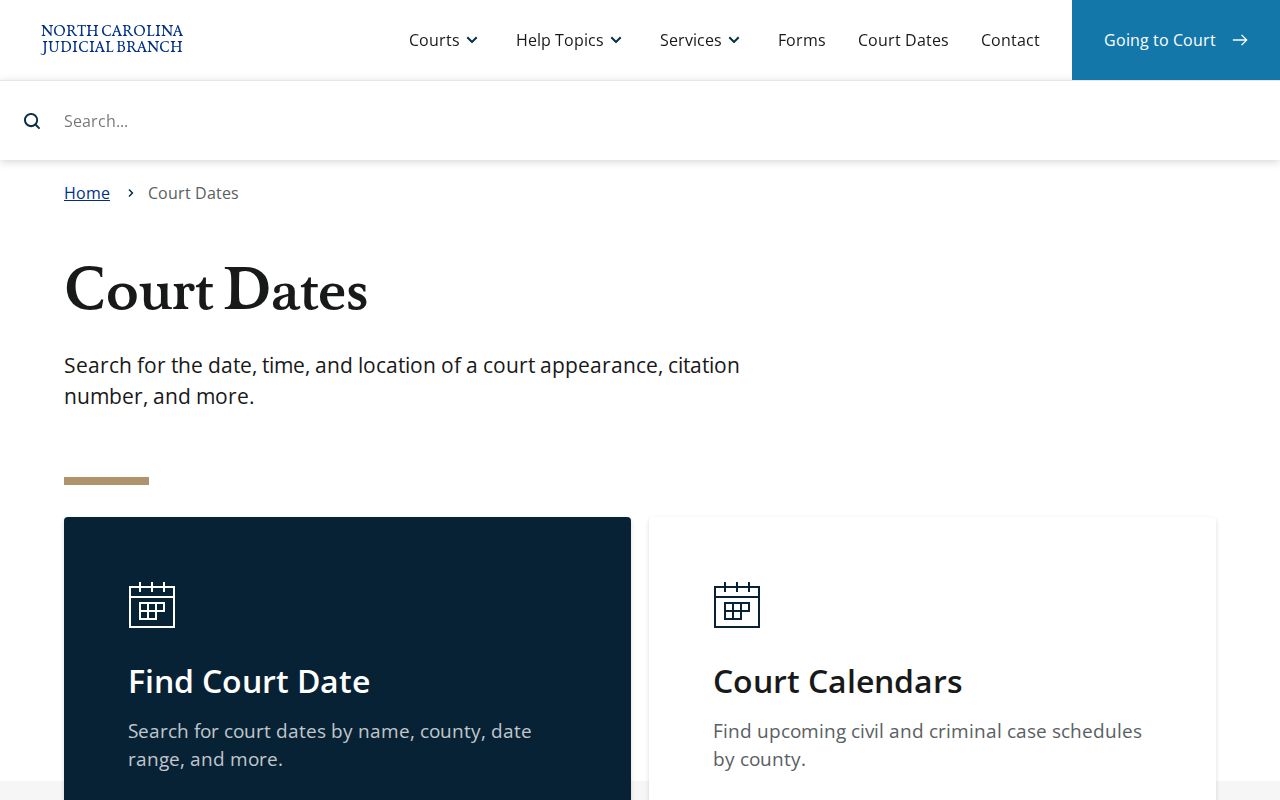
The calendar capture helps locate a proceeding, while the later docket and custody record establish what actually happened.
Confirm Orange County Actual Release
Use the latest NCDAC detail for a state prisoner, and contact NCDAC records when the public display lacks the exact computation. For a county detainee, call the Orange County Detention Center for immediate routing and use the county request portal for the booking and release transaction. For a federal prisoner, the BOP locator date may be projected while the person remains confined and historical after departure.
NC SAVAN through VINELink can send a person-specific custody-event notice. Register while the person remains in a participating agency, and treat the alert as a prompt to verify the source record. The Orange County VINE inmate check explains the phone PIN and confirmation flow. A notice cannot resolve every detainer, transfer, or separate case.
What proves the day? For NCDAC, look for Actual Release Date and the dated movement history. For the jail, request the release date, time, code, and receiving agency. For the court, use the filed order to explain the legal authority, not the exact door-exit time.